Best Fly Floatant and Strike Indicators
Fly floatant and strike indicators are the consumables that make or break a dry fly or nymphing session. The wrong floatant mats a CDC wing and kills the fly's presentation; the wrong indicator is too heavy for a light leader or spooks fish in flat water. We looked at gel, paste, powder, and desiccant floatants for different fly types, plus foam, yarn, and cork indicators for different water and depth conditions.
RiffleDge may earn a commission from links below . Updated June 2026
The short answer
Loon Outdoors Aquel is the best all-around gel floatant for standard hackled and elk-hair dry flies, staying liquid in cold temperatures and coating fly fibers without matting them. Frogs Fanny powder desiccant is the essential companion for reviving a waterlogged fly mid-session. For indicators, the Oros Strike Indicator is the top choice for nymphing in moderate to fast water without spooking fish.
 Top Pick
Loon Outdoors Aquel Premium Floatant
The default gel floatant for most fly fishers: water-based, easy to apply to hackle fibers, and stays liquid enough to use in cold temperatures where oil-based gels become stiff.
Best for Cold and moderate temperature dry fly fishing where you need a gel floatant that stays workable in your hands.
 2
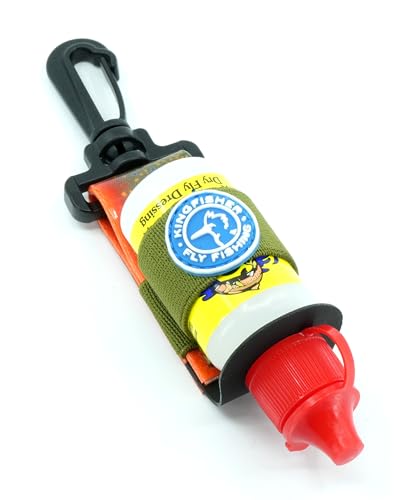
2 Frog's Fanny Dry Fly Floatant
A powder desiccant floatant for reviving waterlogged flies mid-session and treating CDC and deer hair patterns that oil-based gels will ruin by matting the fibers.
Best for Any angler who fishes CDC patterns or needs to quickly revive a drowned dry fly without leaving the run.
 3
3 Gehrke's Gink Fly Floatant
The classic oil-based gel floatant that has been a staple of fly fishing vests since the 1970s. Works well on standard hackled and elk-hair dry flies in warm conditions.
Best for Warm-weather dry fly fishing with standard hackled patterns where the classic gel has decades of proven performance.
 Best Value
Oros Strike Indicators
A round foam indicator with the line encapsulated internally and no small parts to lose on the water, designed to attach and reposition cleanly without creating a hinge point in the leader.
Best for Indicator nymphing in moderate to fast water where the Thingamabobber disrupts the drift and a smaller profile helps.
 5
5 Loon Outdoors Lochsa Floatant
A CDC-specific floatant that coats the delicate fibers of CDC-winged and parachute patterns without matting them, keeping fine-fiber flies floating through multiple drifts.
Best for Anglers who fish CDC midge, Comparadun, or Parachute Adams patterns regularly on flat, spring creek-style water.
 6
6 Thingamabobber Strike Indicator
The classic hollow plastic bubble indicator found in nearly every fly shop, easy to attach via a push-on loop and highly visible in choppy water.
Best for Beginners learning indicator nymphing who want the simplest and most widely available option.
The method
How we chose
We evaluated each option on fit, build quality, daily usability, and value. Our top pick, Loon Outdoors Aquel Premium Floatant, earned the spot. The cold-weather gel standard: does what Gink does in warmth, and keeps doing it when temperatures drop. The comparison above highlights exactly who each pick is best for.
Related guides
FAQ
Best Fly Floatant and Strike Indicators: FAQ
What floatant works best for CDC flies?+
CDC fibers are extremely delicate and oil-based gel floatants like Gink or Aquel will mat them flat, killing the fly's floating ability. Use a dry powder desiccant like Frogs Fanny to restore a waterlogged CDC fly by shaking it in the powder for a few seconds. Loon Lochsa is also formulated specifically for CDC and does not mat the fibers. Avoid all oil-based gels on CDC-winged patterns.
What is the best strike indicator for nymphing?+
For indicator nymphing in moderate to fast water, a small foam or round indicator like the Oros causes less surface disturbance than a large plastic bubble and repositions cleanly without creating a hinge point in the leader. The Thingamabobber is the most available and easiest to attach for beginners. Euro nymphing uses no indicator at all, relying instead on a colored sighter section in the leader to detect strikes visually.
How do I choose indicator size for deep nymphing?+
Use the smallest indicator that still holds your nymph rig off the bottom in the current speed you are fishing. In slower water with lighter rigs a small yarn or micro-cork indicator is enough. In fast deep runs or with tungsten-heavy rigs you need more buoyancy from a larger foam ball. The goal is to see the indicator pause or dip without the weight dragging it under constantly.
Does Gink work in cold weather?+
Gink is an oil-based gel that thickens considerably in cold temperatures and can become difficult to apply when air temperatures drop below about 45 degrees Fahrenheit. Loon Aquel stays fluid in colder conditions because of its formulation. For cold-weather fishing, keep your floatant in an inner pocket close to your body to maintain its working temperature.