Best Fly Box: Silicone, Foam, or Compartment
By RiffleDge . 8 min read . Updated June 2026
A fly box has one job that it either does well or badly: hold your flies securely without crushing them, and let you find and release the one you want quickly. The wrong box is foam too soft to grip a size 22 midge, or a flat box that bends the wire on a heavy stonefly nymph, or a latch that fails and dumps your dry fly selection in the river. The right box depends entirely on what you fish. A silicone-grip box like the Fishpond Tacky Original Fly Box suits dry flies, a compartment box like the Cliff Outdoors Bugger Beast Fly Box suits streamers, and micro-slit foam suits the smallest midges. This guide matches box type to fly type.
The short answer
The Fishpond Tacky Original Fly Box is the best all-around fly box for most anglers: a self-healing silicone grip holds flies of any hook size and releases them one-handed without threading foam. For streamers and large nymphs, a compartment box like the Cliff Outdoors Bugger Beast Fly Box stores big patterns without crushing materials. For size 20 to 26 midges, a micro-slit foam box is the only reliable choice.
This guide contains affiliate links. RiffleDge may earn a commission at no cost to you.
Silicone grip boxes: the modern default for drys and nymphs
Silicone grip boxes replaced foam as the default for most trout anglers, and for good reason. Instead of threading a hook through foam, you press the fly onto a self-healing silicone surface that grips it, then pull it free one-handed when you want it. The Fishpond Tacky Original Fly Box is the benchmark: a slim profile that fits any pocket, a magnetic latch secure enough to survive a pack tip-over, and a grip that holds hooks across the full size range without the splitting and breakdown that foam suffers over seasons.
The trade-off is price compared to a basic foam box, and the silicone shows visible hook-mark patterns over time, though it keeps gripping. For an angler who fishes both drys and small to medium nymphs and wants the fastest, most reliable retrieval in the field, the silicone box is the one to buy first.
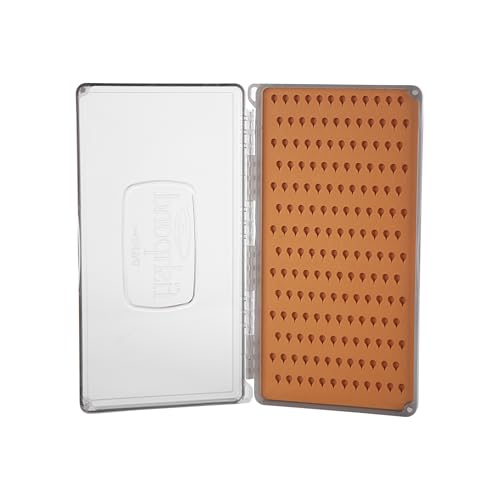
Fishpond Tacky Original Fly Box
A slim fly box with a self-healing silicone grip interior that holds flies of all hook sizes without threading through foam, releases cleanly with one hand, and closes with a secure magnetic latch.
Foam boxes: the budget starting point
Foam flat boxes remain the cheapest way to get organized, and at the entry level the Umpqua Grab and Go Medium Fly Box does the job well: a clear polycarbonate lid lets you identify patterns without opening the box in wind, and the dense foam holds hook points firmly from size 10 through 22. At its budget price you can afford three or four to separate drys from nymphs from specialty patterns, which matters more for finding a fly quickly than box quality does.
The honest limitation of foam is longevity. The foam compresses and loses holding power after two to three seasons of heavy use, and latches can loosen on older units. For a first-season angler building a collection, that trade is worth it; for a daily angler, the silicone box earns its premium over time.

Umpqua Grab and Go Medium Fly Box
A polycarbonate foam-lined fly box with a large clear window for pattern identification and a secure latch, at a price accessible to beginners building their first collection.
Compartment boxes: the right home for streamers and big nymphs
Bead-head nymphs, stoneflies, and streamers do not store well in flat foam. The tungsten bead crushes foam walls, the wire body of a weighted pattern bends under repeated threading, and a heavy fly falls out of a soft slot the moment you open the box. A compartment box solves all three. The Cliff Outdoors Bugger Beast Fly Box has 24 divided compartments sized for big streamers, stonefly nymphs, and saltwater patterns, a waterproof seal that protects contents during a wade, and a clear lid for identifying patterns while closed.
The compartments are too large for small dry flies and midges, and the box is bulkier than a flat foam box for vest pocket storage. This is a specialist box for the large-pattern half of your collection, not a do-everything box. Pair it with a slim silicone or foam box for your smaller flies.
Cliff Outdoors Bugger Beast Fly Box
A large compartment box specifically sized for streamer and larger nymph patterns that do not store well in standard foam slots, with 24 divided compartments and a waterproof seal.
Micro-slit foam: the only reliable storage for tiny midges
Standard foam simply does not hold a size 24 midge. The hook is too small for the foam to grip and the fly works loose and ends up loose in the box. For spring creek and tailwater anglers fishing midge and trico patterns in size 20 to 26, the C and F Design Large System Fly Box is the answer. Its Japanese-made micro-slit foam grips even the smallest hooks without a separate slot or threading, and a waterproof gasket seal protects delicate patterns.
It is a premium price for a foam box, and the micro-slit foam is too tight for hooks above about size 10, so it is a dedicated small-fly box rather than a general one. If you fish tiny flies on flat water, it is the box that finally keeps them where you put them.
C and F Design Large System Fly Box
A Japanese-made waterproof fly box with micro-slit foam that grips even size 24 midges without a separate slot or threading, used by guides who need reliable tiny-fly storage.
How many boxes you actually need
Most trout anglers manage with two to four boxes: one for dry flies sorted by type, one for nymphs and wets sorted by size, one for streamers, and optionally one for specialty patterns like emergers or midges. A chest pack or sling pack typically fits two to three boxes comfortably; a vest holds more but the weight and bulk add up.
Start with one box for drys and one for nymphs and add from there as your collection grows. Whatever you choose, let wet flies air dry before sealing a box, since trapped moisture accelerates hook corrosion. Keep a Loon Outdoors Rogue Zinger and Dr. Slick Cyclone Nipper on your pack so changing the fly you just pulled from the box is a 30-second job, not a 90-second one.

Loon Outdoors Rogue Zinger
A heavy-duty zinger retractor with a 22-inch steel cable and an S-Biner attachment for attaching nippers, hemostats, or a hook sharpener to a vest or pack with instant pull-and-release access.

Dr. Slick Cyclone Nipper
A precision fly fishing nipper with a ceramic cutting edge that stays sharp far longer than stainless steel, plus a hook eye cleaning needle built into the handle for clearing varnish from small hooks.
Featured in this guide
Fishpond Tacky Original Fly Box
A slim fly box with a self-healing silicone grip interior that holds flies of all hook sizes without threading through foam, releases cleanly with one hand, and closes with a secure magnetic latch.
Cliff Outdoors Bugger Beast Fly Box
A large compartment box specifically sized for streamer and larger nymph patterns that do not store well in standard foam slots, with 24 divided compartments and a waterproof seal.
C and F Design Large System Fly Box
A Japanese-made waterproof fly box with micro-slit foam that grips even size 24 midges without a separate slot or threading, used by guides who need reliable tiny-fly storage.
Umpqua Grab and Go Medium Fly Box
A polycarbonate foam-lined fly box with a large clear window for pattern identification and a secure latch, at a price accessible to beginners building their first collection.
Dr. Slick Cyclone Nipper
A precision fly fishing nipper with a ceramic cutting edge that stays sharp far longer than stainless steel, plus a hook eye cleaning needle built into the handle for clearing varnish from small hooks.
Related roundups
FAQ
Frequently asked questions
Is a silicone fly box better than a foam one?+
For hook retention and one-handed release, yes. Silicone grip boxes hold flies more securely across a range of hook sizes and do not split or break down like foam after repeated use. Foam boxes are lighter and cheaper and work well for larger flies, but for small dry flies and reliable long-term grip, silicone is the better choice. Compartment boxes remain the best option for heavy nymphs and streamers.
What fly box is best for streamers and big nymphs?+
A compartment box. Bead-head nymphs and streamers crush foam walls and bend in flat foam slots, while a divided compartment box holds them without deforming the materials. A box with 24 large compartments and a waterproof seal stores big patterns correctly and keeps them dry during a wade. Use it alongside a slim silicone or foam box for smaller flies.
How do I store size 22 to 26 midges so they do not fall out?+
Use a micro-slit foam box designed for tiny hooks. Standard foam cannot grip flies that small, so they work loose. Micro-slit foam, like the kind in premium Japanese-made boxes, grips size 20 to 26 hooks reliably without threading or a separate slot, and a gasket seal protects the delicate patterns. It is the only consistently reliable storage for midges and tricos.
Do fly boxes need to be waterproof?+
For freshwater trout fishing from a vest or pack, a simple snap-closure box is enough; if you drop it the flies dry fine. A waterproof gasket-sealed box matters most for saltwater fishing, boat fishing in spray, or any situation where the box is routinely submerged, because trapped salt water corrodes hooks and ruins flies. Match the seal level to how wet your fishing actually gets.